
Your gateway to a free society
Book

Diary Of A Psychosis: How Public Health Disgraced Itself During COVID Mania
Diary of a Psychosis is different from all other books on Covid: it traces the development of the government response as it happened, bit by bit, and subjects it to relentless scrutiny: did any of it do any good? It thereby preserves some of the crucial day-to-day details that other chronicles have forgotten. And it's those little details of the bizarre behavior of those years that, presented together, preserve for the reader the full horror of the madness of those dark days. The more people know the information in this book, the harder it will be for the ruling classes to do this to us again.
aboutLiberty Portal
Liberty Portal is your gateway for free markets and free thinking. We aggregate open-sourced content to promote and popularize important people and lessons within the liberty movement.


suggested
Ludwig von Mises
Liberalism in the Classical Tradition
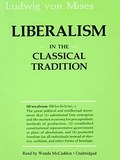
In 1927, classical liberalism, based on a belief in individualism, reason, capitalism, and free trade, was dying, when one of the 20th century's greatest social thinkers wrote this combative and convincing restatement. Nowhere are the key principles of Mises' philosophy better represented than in this timeless work.
Mises was a careful and logical theoretician who believed that ideas rule the world, and this especially comes to light in Liberalism.
"The ultimate outcome of the struggle" between liberalism and totalitarianism, say Mises, "will not be decided by arms, but by ideas. It is ideas that group men into fighting factions, that press the weapons into their hands, and that determine against whom and for whom the weapons shall be used. It is they alone, and not arms, that, in the last analysis, turn the scales."
Robert Murphy
The Politically Incorrect Guide To The Great Depression And The New Deal
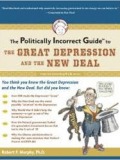
In this timely new P.I. Guide, Murphy reveals the stark truth: free market failure didn't cause the Great Depression and the New Deal didn't cure it. Shattering myths and politically correct lies, he tells why World War II didn't help the economy or get us out of the Great Depression; why it took FDR to make the Depression Great; and why Herbert Hoover was more like Obama and less like Bush than the liberal media would have you believe. Free-market believers and capitalists everywhere should have this on their bookshelf and in their briefcases.
Read more
Murray Rothbard
What Has Government Done To Our Money
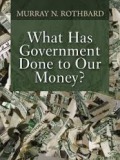
When this gem first appeared in 1963, it took the form of a small paperback designed for mass distribution. We've conjured up that spirit again with this special edition of Rothbard's primer on money and government. Innumerable economists, investors, commentators, and authors have learned from this book through the decades. After fifty years, it remains the best book in print on the topic, a real manifesto of sound money. Rothbard boils down the Austrian theory to its essentials. The book also made huge theoretical advances. Rothbard was the first to prove that the government, and only the government, can destroy money on a mass scale, and he showed exactly how they go about this dirty deed. But just as importantly, it is beautifully written. He tells a thrilling story because he loves the subject so much. The passion that Murray feels for the topic comes through in the prose and transfers to the reader. Readers become excited about the subject, and tell others. Students tell professors. Some, like the great Ron Paul of Texas, have even run for political office after having read it. Rothbard shows precisely how banks create money out of thin air and how the central bank, backed by government power, allows them to get away with it. He shows how exchange rates and interest rates would work in a true free market. When it comes to describing the end of the gold standard, he is not content to describe the big trends. He names names and ferrets out all the interest groups involved. Since Rothbard's death, scholars have worked to assess his legacy, and many of them agree that this little book is one of his most important. Though it has sometimes been inauspiciously packaged and is surprisingly short, its argument took huge strides toward explaining that it is impossible to understand public affairs in our time without understanding money and its destruction.
Read more
support
If you like what we do and want to support us, then you are a fine humanitarian. Click the link below to find out more.
Support the liberty movement
Want to get in touch?