Book

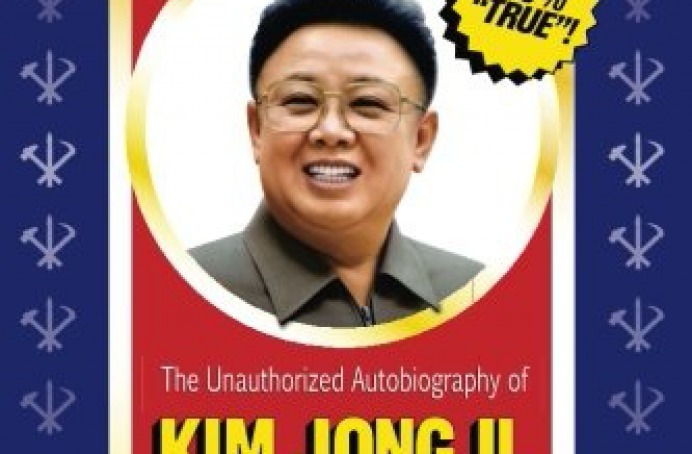
Dear Reader: The Unauthorized Autobiography of Kim Jong Il
No country is as misunderstood as North Korea, and no modern tyrant has remained more mysterious than the Dear Leader, Kim Jong Il. Now, celebrity ghostwriter Michael Malice pulls back the curtain to expose the life story of the "Incarnation of Love and Morality." Taken directly from books spirited out of Pyongyang, DEAR READER is a carefully reconstructed first-person account of the man behind the mythology.
From his miraculous rainbow-filled birth during the fiery conflict of World War II, Kim Jong Il watched as his beloved Korea finally earned its freedom from the cursed Japanese. Mere years later, the wicked US imperialists took their chance at conquering the liberated nation—with devastating results. But that's only the beginning of the Dear Leader's story.
aboutLiberty Portal
Liberty Portal is your gateway for free markets and free thinking. We aggregate open-sourced content to promote and popularize important people and lessons within the liberty movement.

suggested
George Orwell
Animal Farm

George Orwell's timeless and timely allegorical novel—a scathing satire on a downtrodden society’s blind march towards totalitarianism.
“All animals are equal, but some animals are more equal than others.”
A farm is taken over by its overworked, mistreated animals. With flaming idealism and stirring slogans, they set out to create a paradise of progress, justice, and equality. Thus the stage is set for one of the most telling satiric fables ever penned—a razor-edged fairy tale for grown-ups that records the evolution from revolution against tyranny to a totalitarianism just as terrible.
When Animal Farm was first published, Stalinist Russia was seen as its target. Today it is devastatingly clear that wherever and whenever freedom is attacked, under whatever banner, the cutting clarity and savage comedy of George Orwell’s masterpiece have a meaning and message still ferociously fresh.
Read more“All animals are equal, but some animals are more equal than others.”
A farm is taken over by its overworked, mistreated animals. With flaming idealism and stirring slogans, they set out to create a paradise of progress, justice, and equality. Thus the stage is set for one of the most telling satiric fables ever penned—a razor-edged fairy tale for grown-ups that records the evolution from revolution against tyranny to a totalitarianism just as terrible.
When Animal Farm was first published, Stalinist Russia was seen as its target. Today it is devastatingly clear that wherever and whenever freedom is attacked, under whatever banner, the cutting clarity and savage comedy of George Orwell’s masterpiece have a meaning and message still ferociously fresh.
Stefan Molyneux
Practical Anarchy: The Freedom of the Future

Imagine a world without government – this thought exercise seems impossible for many, because the power and reach of state monopolies is so omnipresent in our lives. However, there is no rational, economic or moral reason to assume that governments are necessary for the provision of roads, healthcare, charity, dispute resolution, courts, policing, national defense, jails – or any of the other services currently monopolized by the state.
Governments are extremely dangerous, responsible for over 250 million deaths in the 20th century alone – if it is possible to run a society without a government, surely this is something that we must strive towards as a species.
Practical Anarchy makes strong case for the private – that is to say voluntary – provision for public services. It reveals the idea of government as a dangerous and unnecessary anachronism, and points the way towards a peaceful and voluntary future for mankind.
Read moreGovernments are extremely dangerous, responsible for over 250 million deaths in the 20th century alone – if it is possible to run a society without a government, surely this is something that we must strive towards as a species.
Practical Anarchy makes strong case for the private – that is to say voluntary – provision for public services. It reveals the idea of government as a dangerous and unnecessary anachronism, and points the way towards a peaceful and voluntary future for mankind.
Murray Polner & Tom Woods
We Who Dared to Say No to War: American Antiwar Writing from 1812 to Now

We Who Dared to Say No to War uncovers some of the forgotten but compelling body of work from the American antiwar tradition—speeches, articles, poetry, book excerpts, political cartoons, and more—from people throughout our history who have opposed war. Beginning with the War of 1812, these selections cover every major American war up to the present and come from both the left and the right, from religious and secular viewpoints. There are many surprises, including a forgotten letter from a Christian theologian urging Confederate President Jefferson Davis to exempt Christians from the draft and a speech by Abraham Lincoln opposing the 1848 Mexican War. Among others, Daniel Webster, Mark Twain, Andrew Carnegie, Grover Cleveland, Eugene Debs, Robert Taft, Paul Craig Roberts, Patrick Buchanan, and Country Joe and the Fish make an appearance. This first-ever anthology of American antiwar writing offers the full range of the subject's richness and variety.
Read more