

The War Against Boys
Girls and women were once second-class citizens in the nation's schools. Americans responded w ith concerted efforts to give girls and women the attention and assistance that was long overdue. Now, after two major waves of feminism and decades of policy reform, women have made massive strides in education. Today they outperform men in nearly every measure of social, academic, and vocational well-being.
Christina Hoff Sommers contends that it's time to take a hard look at present-day realities and recognize that boys need help. Called "provocative and controversial . . . impassioned and articulate" ("The Christian Science M"onitor), this edition of "The War Against Boys" offers a new preface and six radically revised chapters, plus updates on the current status of boys throughout the book.
Sommers argues that the problem of male underachievement is persistent and worsening. Among the new topics Sommers tackles: how the war against boys is harming our economic future, and how boy-averse trends such as the decline of recess and zero-tolerance disciplinary policies have turned our schools into hostile environments for boys. As our schools become more feelings-centered, risk-averse, competition-free, and sedentary, they move further and further from the characteristic needs of boys. She offers realistic, achievable solutions to these problems that include boy-friendly pedagogy, character and vocational education, and the choice of single-sex classrooms.
"The War Against Boys" is an incisive, rigorous, and heartfelt argument in favor of recognizing and confronting a new reality: boys are languishing in education and the price of continued neglect is economically and socially prohibitive.
aboutLiberty Portal



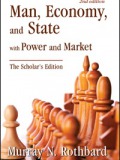
Rothbard's great treatise and its complementary text combined into a single 4.5"x7" pocket edition!
Murray N. Rothbard's great treatise Man, Economy, and State and its complementary text Power and Market, are here combined into a single edition as they were written to be. It provides a sweeping presentation of Austrian economic theory, a reconstruction of many aspects of that theory, a rigorous criticism of alternative schools, and an inspiring look at a science of liberty that concerns nearly everything and should concern everyone.
The Mises Institute's new edition of Man Economy, and State, united with its formerly sundered companion volume Power and Market, is a landmark in the history of the Institute. It takes this book out of the category of underground classic and raises it up to its proper status as one of the great economic treatises of all time, a book that is essential for anyone seeking a robust economic education.
This new edition will take your breath away with its beauty and quality. It's remarkable that a book this thick could lay so flat and be so durable with super-solid binding. It somehow turns out not to be unweildy. Get it with the Study Guide(from mises org or amazon) and you will have what you need.
The captivating new introduction by Professor Joseph Salerno that frames up the Rothbardian contribution in a completely new way, and reassesses the place of this book in the history of economic thought. In Salerno's view, Rothbard was not attempting to write a distinctively "Austrian" book but rather a comprehensive treatise on economics that eschewed the Keynesian and positivist corruptions. This is what accounts for its extraordinarily logical structure and depth. That it would later be called Austrian is only due to the long-lasting nature of the corruptions of economics that Rothbard tried to correct.
For years, the Mises Institute has kept it in print and sold thousands of copies in a nice paperback version. Then we decided to take a big step and put out an edition worthy of this great treatise. It is the Scholar's Edition of Man, Economy, and State -an edition that immediately became definitive and used throughout the world. The footnotes (which are so brilliant and informative!) are at the bottom of every page. The index is huge and comprehensive. The binding is impeccable and its beauty unmatched.
Students have used this book for decades as the intellectual foil for what they have been required to learning from conventional economics classes. In many ways, it has built the Austrian school in the generation that followed Mises. It was Rothbard who polished the Austrian contribution to theory and wove it together with a full-scale philosophy of political ethics that inspired the generation of the Austrian revival, and continues to fuel its growth and development today.
From Rothbard, we learn that economics is the science that deals with the rise and fall of civilization, the advancement and retrenchment of human development, the feeding and healing of the multitudes, and the question of whether human affairs are dominated by cooperation or violence.
Economics in Rothbard's wonderful book emerges as the beautiful logic of that underlies human action in a world of scarcity, the lens on how exchange makes it possible for people to cooperate toward their mutual betterment. We see how money facilitates this, and allows for calculation over time that permits capital to expand and investment to take place. We see how entrepreneurship, based on real judgments and risk taking, is the driving force of the market.
What's striking is how this remarkable book has lived in the shadows for so long. It began as a guide to
support
If you like what we do and want to support us, then you are a fine humanitarian. Click the link below to find out more.
Support the liberty movement