
Your gateway to a free society
Book
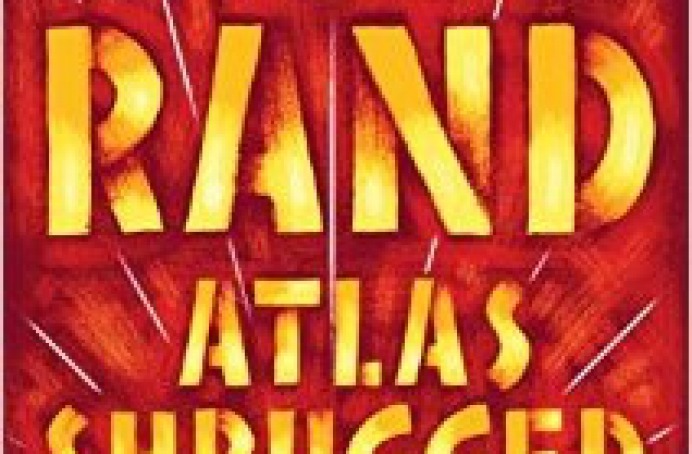
Atlas Shrugged
intellectual mystery story that integrates ethics, metaphysics, epistemology, politics, economics, and sex.
Set in a near-future U.S.A. whose economy is collapsing as a result of the mysterious disappearance of leading innovators and industrialists, this novel presents an astounding panorama of human life-from the productive genius who becomes a worthless playboy...to the great steel industrialist who does not know that he is working for his own destruction...to the philosopher who becomes a pirate...to the woman who runs a transcontinental railroad...to the lowest track worker in her train tunnels.
Peopled by larger-than-life heroes and villains, charged with towering questions of good and evil, Atlas Shrugged is a philosophical revolution told in the form of an action thriller.
Set in a near-future U.S.A. whose economy is collapsing as a result of the mysterious disappearance of leading innovators and industrialists, this novel presents an astounding panorama of human life-from the productive genius who becomes a worthless playboy...to the great steel industrialist who does not know that he is working for his own destruction...to the philosopher who becomes a pirate...to the woman who runs a transcontinental railroad...to the lowest track worker in her train tunnels.
Peopled by larger-than-life heroes and villains, charged with towering questions of good and evil, Atlas Shrugged is a philosophical revolution told in the form of an action thriller.
aboutLiberty Portal
Liberty Portal is your gateway for free markets and free thinking. We aggregate open-sourced content to promote and popularize important people and lessons within the liberty movement.




suggested
Murray Rothbard
What Has Government Done To Our Money
When this gem first appeared in 1963, it took the form of a small paperback designed for mass distribution. We've conjured up that spirit again with this special edition of Rothbard's primer on money and government. Innumerable economists, investors, commentators, and authors have learned from this book through the decades. After fifty years, it remains the best book in print on the topic, a real manifesto of sound money. Rothbard boils down the Austrian theory to its essentials. The book also made huge theoretical advances. Rothbard was the first to prove that the government, and only the government, can destroy money on a mass scale, and he showed exactly how they go about this dirty deed. But just as importantly, it is beautifully written. He tells a thrilling story because he loves the subject so much. The passion that Murray feels for the topic comes through in the prose and transfers to the reader. Readers become excited about the subject, and tell others. Students tell professors. Some, like the great Ron Paul of Texas, have even run for political office after having read it. Rothbard shows precisely how banks create money out of thin air and how the central bank, backed by government power, allows them to get away with it. He shows how exchange rates and interest rates would work in a true free market. When it comes to describing the end of the gold standard, he is not content to describe the big trends. He names names and ferrets out all the interest groups involved. Since Rothbard's death, scholars have worked to assess his legacy, and many of them agree that this little book is one of his most important. Though it has sometimes been inauspiciously packaged and is surprisingly short, its argument took huge strides toward explaining that it is impossible to understand public affairs in our time without understanding money and its destruction.
Read more
Scott Adams
How to Fail at Almost Everything and Still Win Big: Kind of the Story of My Life
Blasting clichéd career advice, the contrarian pundit and creator of Dilbert recounts the humorous ups and downs of his career, revealing the outsized role of luck in our lives and how best to play the system.
Scott Adams has likely failed at more things than anyone you’ve ever met or anyone you’ve even heard of. So how did he go from hapless office worker and serial failure to the creator of Dilbert, one of the world’s most famous syndicated comic strips, in just a few years? In How to Fail at Almost Everything and Still Win Big, Adams shares the game plan he’s followed since he was a teen: invite failure in, embrace it, then pick its pocket.
No career guide can offer advice that works for everyone. As Adams explains, your best bet is to study the ways of others who made it big and try to glean some tricks and strategies that make sense for you. Adams pulls back the covers on his own unusual life and shares how he turned one failure after another—including his corporate career, his inventions, his investments, and his two restaurants—into something good and lasting. There’s a lot to learn from his personal story, and a lot of entertainment along the way. Adams discovered some unlikely truths that helped to propel him forward. For instance:
• Goals are for losers. Systems are for winners.
• “Passion” is bull. What you need is personal energy.
• A combination of mediocre skills can make you surprisingly valuable.
• You can manage your odds in a way that makes you look lucky to others.
Adams hopes you can laugh at his failures while discovering some unique and helpful ideas on your own path to personal victory. As he writes: “This is a story of one person’s unlikely success within the context of scores of embarrassing failures. Was my eventual success primarily a result of talent, luck, hard work, or an accidental just-right balance of each? All I know for sure is that I pursued a conscious strategy of managing my opportunities in a way that would make it easier for luck to find me.”
Read moreScott Adams has likely failed at more things than anyone you’ve ever met or anyone you’ve even heard of. So how did he go from hapless office worker and serial failure to the creator of Dilbert, one of the world’s most famous syndicated comic strips, in just a few years? In How to Fail at Almost Everything and Still Win Big, Adams shares the game plan he’s followed since he was a teen: invite failure in, embrace it, then pick its pocket.
No career guide can offer advice that works for everyone. As Adams explains, your best bet is to study the ways of others who made it big and try to glean some tricks and strategies that make sense for you. Adams pulls back the covers on his own unusual life and shares how he turned one failure after another—including his corporate career, his inventions, his investments, and his two restaurants—into something good and lasting. There’s a lot to learn from his personal story, and a lot of entertainment along the way. Adams discovered some unlikely truths that helped to propel him forward. For instance:
• Goals are for losers. Systems are for winners.
• “Passion” is bull. What you need is personal energy.
• A combination of mediocre skills can make you surprisingly valuable.
• You can manage your odds in a way that makes you look lucky to others.
Adams hopes you can laugh at his failures while discovering some unique and helpful ideas on your own path to personal victory. As he writes: “This is a story of one person’s unlikely success within the context of scores of embarrassing failures. Was my eventual success primarily a result of talent, luck, hard work, or an accidental just-right balance of each? All I know for sure is that I pursued a conscious strategy of managing my opportunities in a way that would make it easier for luck to find me.”
Tom Woods
The Politically Incorrect Guide to American History
Claiming that most textbooks and popular history books were written by biased left-wing writers and scholars, historian Thomas Woods offers this guide as an alternative to "the stale and predictable platitudes of mainstream
Read more
support
If you like what we do and want to support us, then you are a fine humanitarian. Click the link below to find out more.
Support the liberty movement
Want to get in touch?